Decentralized identity, open standards
LedgerDomain's platform delivers secure, authenticated data to the U.S. pharmaceutical supply chain. Built on open standards, our stack features identity-driven master data management, privacy-first file and message sharing, and clean integrations with mature systems.
Identity you can verify — for years, not seconds
Every credential, message, and file we handle is anchored to decentralized identifiers your partners can verify independently, without depending on any single provider. That makes trust portable across the supply chain and durable over time. The LedgerDomain identity platform was built in close collaboration with stakeholders in every sector, including a public-private partnership with the industry and FDA.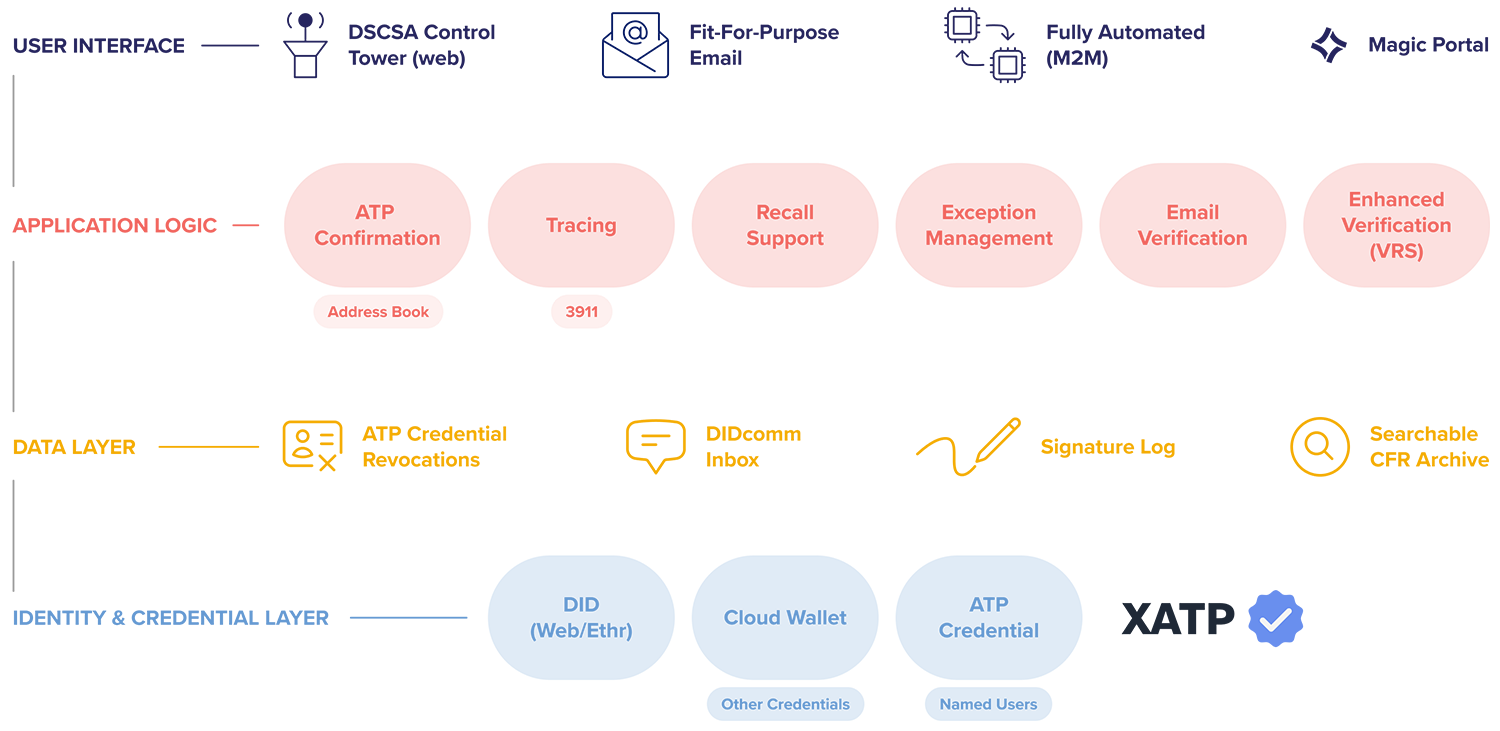
Decentralized identifiers
Portable, cryptographically verifiable identifiers (DIDs) that don't rely on a central directory. Partners resolve and trust them on their own terms.Verifiable credentials
Tamper-evident credentials — ATP status, licensure, product data — that any counterparty can check instantly, offline, and after the fact.Secure applications
Privacy-first file and message sharing, a scalable deployment architecture, and lightweight clients — the secure plumbing behind every workflow.Interoperability begins with open standards
Interoperability isn't a feature we bolt on; it's the foundation. We work closely with the industry to develop and build trusted standards.
W3C compliance
Credentials and presentations that conform to the W3C data model, verifiable by anyone.
OCI compliance
Aligned with the Open Credentialing Initiative for ATP credentialing across the pharma supply chain.
PDG compliance
Built to the Partnership for DSCSA Governance interoperability blueprint for lawful, electronic data exchange.Introducing a fit-for-purpose DID method
The W3C did:web method is simple and easy to implement — but many implementations treat verifiable presentations as ephemeral, checked only at the moment they're received. Highly regulated industries like the U.S. pharmaceutical supply chain need to confirm a presentation's historical validity for years after it was created.
did:webplus is a balanced, fit-for-purpose extension of did:web that delivers stronger guarantees with a moderate implementation lift.
- Immutability and auditability for every credential
- Seamless key rotation with a complete key-usage history
- Stronger guarantees — without the weight of a full blockchain
- Built for regulated ecosystems, and released for any similarly situated community
The did:webplus stack
Open-source components you can run today as Docker images on GHCR. A DID's history lives in a verifiable microledger; these services create, host, resolve, and verify it.
did-webplus-cli
Client-side operations — DID resolution, creation, and key updates — from the command line.
Readme →Verifiable Data Registry
Reference service that hosts a DID's microledger so its full update history stays available and auditable.
Readme →Verifiable Data Gateway
Reference service for fetching and verifying DID data across registries on behalf of relying parties.
Readme →Universal Resolver Driver
Plugs did:webplus into the DIF Universal Resolver so any ecosystem can resolve it with familiar tooling.
Readme →ghcr.io/ledgerdomain/did-webplus-clidid-webplus-vdrdid-webplus-vdgdid-webplus-urdBuild on decentralized identity
Talk to us about credentials, tracing, and verifiable data for your supply chain — or dive straight into the open-source project.
From blockchain pilots to fit-for-purpose identity
Our work began with landmark blockchain pilots. In 2019, the FDA selected LedgerDomain and UCLA Health for its DSCSA Pilot Project Program, and our BRUINchain system tracked real medications to the refrigerator level inside UCLA Health’s specialty pharmacy. That work, and the credentialing study that followed with supply-chain leaders at Genentech, Amgen, and Sanofi, is peer-reviewed in Blockchain in Healthcare Today and collected in our publications library.
Those pilots taught us where heavyweight distributed ledgers genuinely help and where they get in the way. They led us directly to lighter-weight, standards-based decentralized identity like did:webplus. The principles we took away are set out in Ten Axioms for Digital Identity.
LedgerDomain is a member of:
- Healthcare Distribution Alliance (HDA)
- HIMSS
- GS1 US Healthcare
- Partnership for DSCSA Governance (PDG)
- Open Credentialing Initiative (OCI)
- Clinical Supply Blockchain Working Group (CSBWG)